If you run a small business with hourly or shift-based employees,
there’s a good chance a slice of your payroll is quietly
disappearing to something you’ve never actually seen happen:
buddy punching. See how Attenzo stops it with selfie and geofence
verification at
Attenzo →
What Is Buddy Punching?
Buddy punching is when one employee clocks in or out on behalf
of a coworker who isn’t actually present — using a shared ID
card, a PIN, a signature, or simply signing the register for a
friend who’s running late, left early, or didn’t come in at all.
It’s rarely malicious in the way outright fraud is. Most of the
time it’s a favor between coworkers: “just punch me in, I’ll be
there in twenty minutes.” But favors add up, and from the
business’s side, it looks identical to full attendance — until
you look at the payroll bill.
Why It Happens — and Who’s Most at Risk
Buddy punching thrives wherever attendance verification depends
on something that can be handed to someone else:
- Shared or unattended sign-in systems — a physical register, a shared tablet, a single PIN pad
- Multiple shift locations or field teams — supervisors can’t be everywhere at once
- Loose ID/badge systems — a swipe card left on a desk works the same whether the owner is in the building or not
- High-turnover, informal teams — retail, hospitality, delivery, and field service teams are especially exposed
Small businesses are disproportionately affected — not because
their employees are less honest, but because they typically
can’t afford a full-time supervisor watching every entry point.
The Real Cost — It’s More Than the Stolen Hours
It’s tempting to think of buddy punching as “a few minutes here
and there,” but the cost compounds:
- Payroll inflation — you’re paying for hours that were never worked, every pay cycle
- Inaccurate labor data — every staffing and overtime decision built on wrong attendance data is built on bad data
- Morale damage — honest, punctual employees notice when a coworker gets away with it, and it changes their own behavior too
None of this shows up as one alarming number. It shows up as a
slow, steady leak — which is exactly why it’s so easy to
underestimate.
Why the Old Fixes Don’t Actually Work
Most of the “solutions” businesses already have in place were
never designed to stop this:
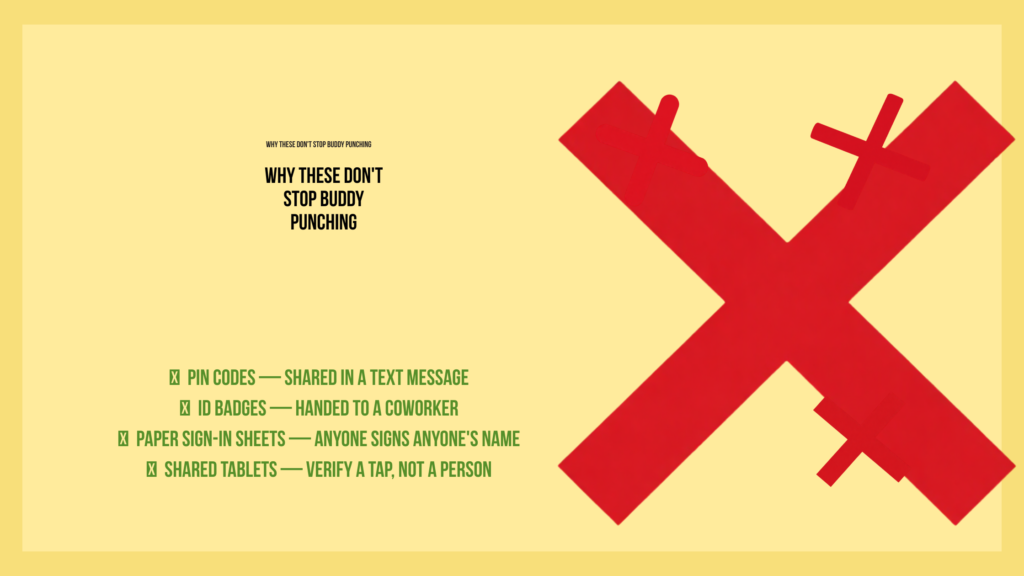
- PIN codes — can be shared in a text message
- ID badges/swipe cards — can be handed to a coworker in two seconds
- Paper sign-in sheets — anyone can sign anyone’s name
- A shared tablet at the entrance — verifies that someone tapped in, not who
These systems were built to record attendance, not to verify
identity or location. That distinction is the entire problem.
What Actually Stops It: Verification, Not Just Recording
The fix isn’t more paperwork or stricter warnings — it’s closing
the two gaps that make buddy punching possible in the first place:
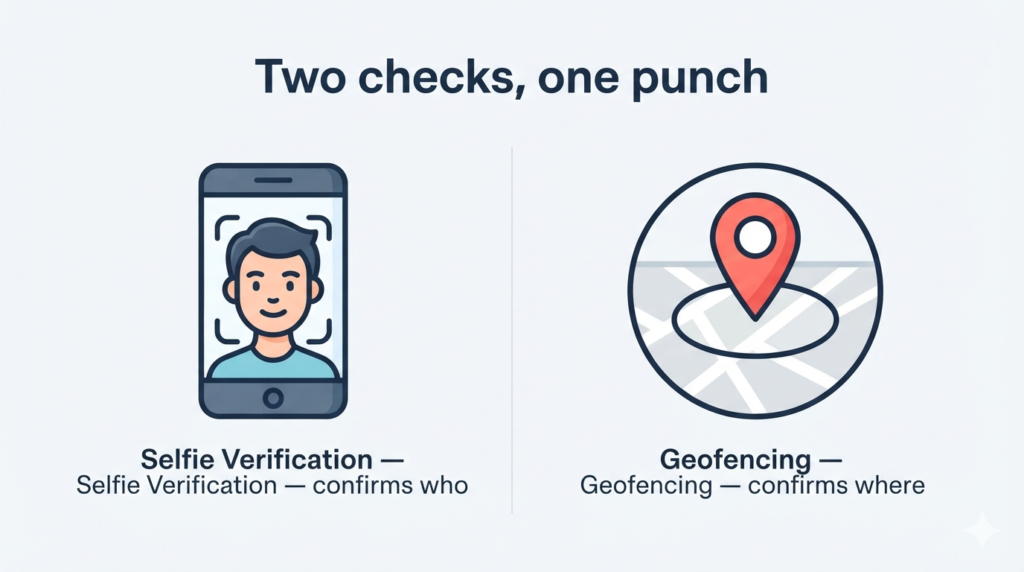
Selfie verification ties every punch-in to a
live photo of the actual person clocking in. You can hand
someone your PIN or your badge. You can’t hand them your face.
Geofencing ties every punch-in to a verified
location — so an employee can only clock in when they’re
actually within range of the workplace, not from home, not
from a coffee shop down the road.
Together, these two checks answer the two questions PINs,
badges, and paper never could: who is punching in, and where
are they when they do it.
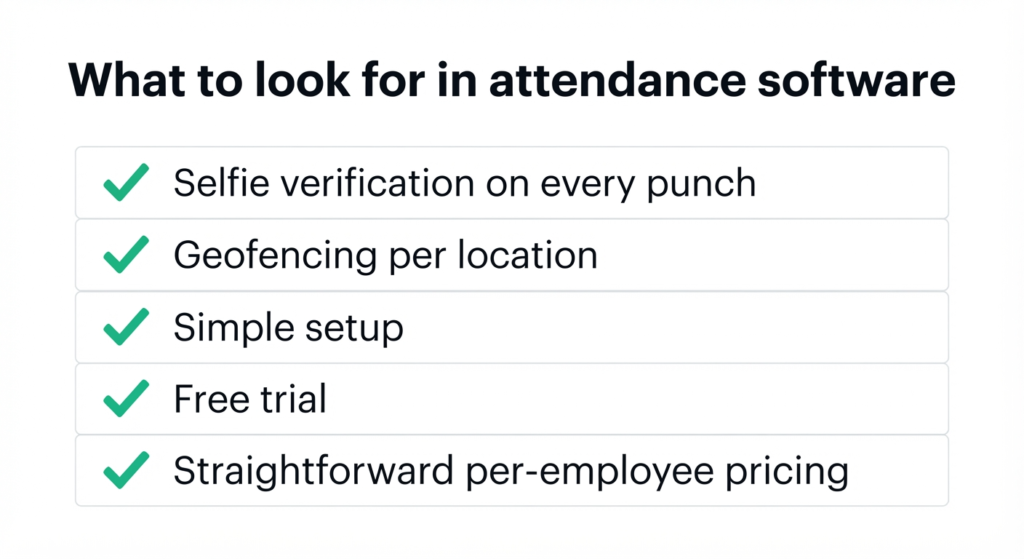
A Short Checklist for Choosing Attendance Software
If you’re evaluating attendance tools to close this gap, check
for:
- Selfie verification on every punch — not buried in a higher-tier plan
- Geofencing tied to your actual work location(s) — configurable per site if you have more than one
- Simple setup — no IT team required to roll out to a small team
- A free trial — so you can see it working with your actual team before paying
- Straightforward, per-employee pricing — scales sensibly whether you have 5 employees or 50
Try It With Your Own Team
Attenzo covers all of the above — selfie punch, geofence
verification, and simple leave management, with a free trial
so you can see it working with your own team before you pay
for anything.

Leave a Reply